

It’s clear to anyone passionate about travel that AI is rapidly transforming the way we explore the world – from trip planning and border crossings to navigating new destinations and creating travel content. As a frequent traveler and content creator, I wanted to share my honest take on how AI is changing the way we travel, along with my thoughts on new technologies and what’s next.
- This post was created in partnership with HandyVisas.com and contains affiliate links. If you make a purchase through these links, I may earn a small commission – at no additional cost to you. For more details, please read my full disclosure.
How AI Is Changing the Way We Travel
As a frequent traveler and content creator immersed in the ongoing shift that AI and new technologies are bringing to the travel world, I wanted to share my honest thoughts and firsthand experiences. There’s no doubt that AI is opening up exciting new possibilities for those of us who love to explore – but with innovation also come questions, risks, and uncertainties that are worth discussing.
In this article, I’ll explore the key ways AI is shaping the future of travel – from my personal perspective – sharing what I’ve tested and experienced firsthand, and what I’m most excited to see AI enhance in how we travel today.

Planning Itineraries with AI: My Firsthand Experience
AI-powered trip planners and platforms like Google Travel, ChatGPT, TripIt, and others can now generate personalized itineraries in seconds. You simply enter your dates, interests, and travel preferences, and the AI produces a custom travel plan. To my surprise, after testing, I discovered that for city breaks and popular tourist destinations, many of these tools are already quite helpful. They consolidate information, reduce the need to open countless tabs, and even handle logistics like routing and timing.
HandyVisas recently shared an interesting survey on Facebook revealing that 90% of their followers have used AI to plan or book their travels. So it is obvious that AI apps have already become essential tools for many of us.
However, as a travel content creator who frequently explores lesser-known destinations I know well, I’ve been testing AI tools out of curiosity – and this is where their limitations become clear. What concerns me most is how confidently ChatGPT (and similar tools) can present inaccurate or incomplete information. If I didn’t know the destinations personally, I could’ve easily been misled. The suggestions often gave advice that was not only overly generic but sometimes factually wrong. When I tried to clarify or correct errors, ChatGPT would simply apologize and agree – without offering insight into the source of the mistake.
This raises a red flag: who’s accountable for incorrect travel advice when no one is clearly responsible? AI planning tools can be helpful, but they’re currently no substitute for genuine local insight or meaningful, experience-driven travel planning. For now, I still rely on additional research myself – travel blogs, Pinterest boards, reviews on TripAdvisor and Google – to ensure the details are accurate and authentic.
Therefore, for now, AI is already a useful assistant for trip planning – especially for mainstream destinations. However, it still can’t match the depth, context, and personal touch of human-generated travel content. As the technology continues to evolve, we’ll see what happens, but for the moment, AI is a great starting point – not the final answer.

Can AI Simplify Visas and Border Crossings? Here’s What I’m Hoping For
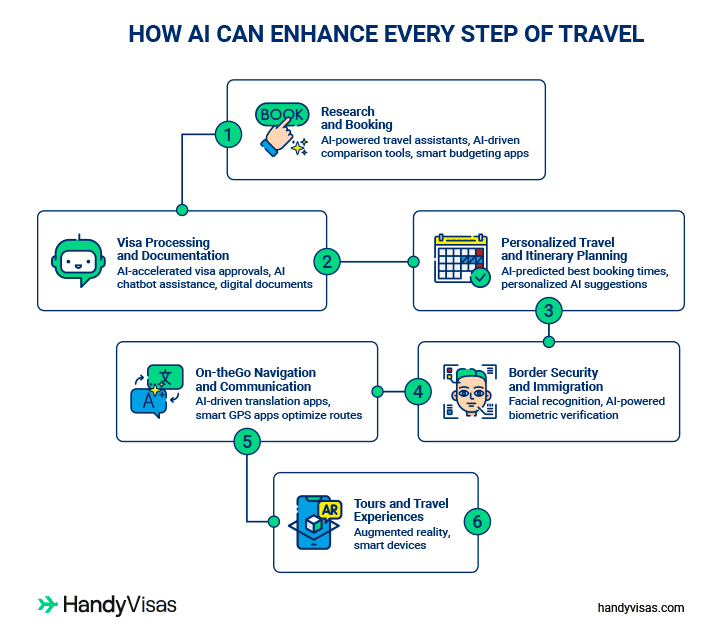
One area where AI holds truly exciting potential is in border management and visa processing. Having navigated complex visa requirements and spent countless hours at border controls in multiple countries, I genuinely see this as the transformative breakthrough I’ve been waiting for in travel technology.
HandyVisas, a hassle-free expert service for international visa and entry authorization applications, emphasizes the incredible potential of AI to simplify visa procedures and deliver faster, more efficient results. By speeding up application processing, reducing errors through automated document checks, and detecting fraud by identifying inconsistencies, AI significantly enhances the overall experience. Additionally, AI-powered chatbots offer 24/7 support, guiding applicants through every step of the process. As this technology continues to evolve, visa applications could become quicker, more accurate, and far less stressful for travelers worldwide.
Yes, please – we definitely need this!
At border crossings, AI-powered biometrics and automated decision-making mean fewer queues and faster approvals. This is promising for global nomads and frequent travelers who have struggled with inconsistent, confusing, or just plain hostile experiences at passport control. For many countries, AI’s ability to reduce bureaucratic friction is arguably the most substantial win in the travel sector right now.
Let’s be honest – many countries still have complex visa requirements that the average traveler knows little about, so AI won’t replace expert advice and assistance anytime soon. While the world has been globalizing over the past decades, recent trends seem to be moving in the opposite direction. I don’t expect governments to make their websites more user-friendly or for visa applications to disappear and suddenly become easy for travelers. In fact, the current political climate suggests regulations and requirements may only increase. However, my greatest hope is that AI will greatly enhance the entire process, making the overall experience much simpler and smoother for travelers.
Given the current climate of trade wars, political tensions, and constant changes, I wouldn’t fully trust AI to handle my visa application. If you’re traveling to a destination that requires a visa and want a hassle-free experience, it’s wiser not to risk a refusal – opt for professional services like HandyVisas and always check reviews before choosing a visa provider.

Smarter Navigation and Communication with AI in Travel
Everyone who’s had even a passing interest in AI has heard about the big announcements from the Google I/O 2025 developer conference in May. I was thrilled to learn that Google has confirmed the rollout of new Google Translate features, including real-time, conversational translation. This marks another exciting evolution of AI in travel that I can’t wait to experience.
Imagine being able to speak with your Booking.com host or taxi driver in real time – each of you using a different language – and still be instantly understood. AI-powered navigation apps could interpret local events, reroute you around disruptions, and offer hyperlocal recommendations as you move. I’m honestly so excited about these innovations. These tools aren’t just convenient while traveling – they would make me feel more confident and secure, with access to up-to-the-minute information anywhere in the world.
AI and the New Era for Travel Content Creators
While AI is rapidly transforming many industries, I can tell you firsthand – as a travel content creator – that things feel more uncertain than ever. Most travel blogs, mine included, rely heavily on traffic from Google. But with recent changes to Google’s algorithms and the rollout of AI tools like AI Overviews, many creators are feeling discouraged.
AI Overviews often display answers directly at the top of search results, pushing independent blogs further down the page. As a result, many travel writers have seen significant drops in traffic and are now questioning whether they can continue doing this work if AI-generated summaries begin to overshadow human voices.
The irony is that it’s human-created, original travel content that feeds AI models. AI doesn’t travel. It doesn’t explore new destinations or capture real experiences – it simply pulls and summarizes what others have already written. So if creators stop producing content because they can no longer earn a living, where will AI get its information in the future?
Google has repeatedly stated that human-created content is essential to the health of search. The hope is that we’re moving toward a future where AI tools support and elevate original creators – not replace them. Personally, I believe AI is most powerful when it amplifies real stories, voices, and expertise – not when it tries to substitute them entirely. And honestly, I think even the biggest AI enthusiasts don’t want that future.
In my own blogging and online writing, I regularly use AI for brainstorming, editing, and speeding up my drafts. These tools are great for cutting down on busywork – but I can almost always tell when something was written entirely by AI. I often stop reading after a few sentences because I’m unsure if the information is accurate or reliable, and it feels uninteresting without any personal experience behind it.
Speaking from personal experience – as someone who frequently plans and researches international trips – I still genuinely crave authentic, personal perspectives to inspire my next adventure.


To sum up, it’s clear that AI is steadily reshaping every aspect of how we travel, research, and plan future trips – often for the better. Its capacity to analyze vast amounts of data, provide quick and relevant answers, and automate lengthy bureaucratic processes is an invaluable tool that humanity can and should leverage. That said, it’s crucial that we continue educating ourselves to use AI thoughtfully, because the true potential emerges when human insight is combined with technological efficiency.
Unlike many people these days who tend to be pessimistic, I’m actually quite optimistic about the changes AI is bringing to the travel industry. Yes, there are real risks – and as content creators, many of us will need to adapt. That might mean diversifying our income streams, offering products or services, and becoming more active on social media. A purely informational website may no longer be enough to make a full-time living.
Still, I see the integration of AI into travel as mostly positive. It has the potential to save us time and money, and could greatly improve stressful parts of travel like visa applications and border control by making them more efficient. Of course, there’s a huge responsibility on tech companies like Google, Microsoft, and OpenAI to ensure AI benefits users without undermining the original sources of information. As I’ve said before – if travel bloggers stop creating content, AI won’t have anything valuable to pull from, and readers could lose access to genuinely helpful insights.
So while there will be ups and downs ahead, I’m hopeful that AI’s ability to analyze and surface meaningful content will ultimately help elevate the most unique and helpful travel blogs and platforms.
Pin it:

- Accommodation: For short stays, I usually book via Agoda and Booking
- Tours&excursions: My favorites for guided tours are GetYourGuide and Viator
- Museums&attractions: Get mobile tickets for attractions via Tiqets (use ATC5 code for a 5% discount via this link)
- Semi-private & private tours: LivTours is my favorite place for unique & crafted experiences in Europe
- For Foodies: Eatwith is a unique platform for finding culinary experiences with locals around the world
- Audio guides: Book audio excursions & tours in 35+ countries via WeGoTrip
- Flights: Find the best deals with Skyscanner and Kiwi
- Driving in a new country? – Check out Tripiamo guides (do not miss Tripiamo Driving in Spain Guide)
- Train&bus tickets: Currently, I book via Omio (10% off with code ATC10 for first-time customers)
- Car rental: To find the best deals, I use Discover Cars
- Top E-Sim: To avoid roaming fees, I like Holafly (use ATLIFESTYLECROSSROADS for for a 5% discount)
- Shop My Level8 Suitcase: get 15% off with the code ATC15 here
- Internet Security on the road: Connect safely to public Wi-Fi and bypass censorship with NordVPN
- Transfers: For individual transfer services, I like GetTransfer and Kiwitaxi
- Suitcases&Luggage: Discover where to store your luggage on the go with Radical Storage
- Travel Insurance: Find the best trip insurance plans via VisitorsCoverage and EKTA
- Compensation for delayed/canceled flights: Check out AirHelp and Compensair
- Renting Bikes: To find motorcycles, scooters, quads, and bicycles, I use BikesBooking
- Package Tours: Head to CheapOair and Expedia
- For Bloggers: To monetize my blog, I work with Travelpayouts and Stay22
- Website Owners: For hosting services, I work with and recommend Lyrical Host (get 10% off with my code ATC10)


Thanks for your opinions on AI. I am trying to embrace AI and so far it has been helpful with my travel planning. Only the future will tell how good, or bad, it might be.
Interesting read! I’ve also definitely noticed AI making a lot of mistakes especially related to travel! I do find it helpful for the beginning stages of planning a trip though!
Hello! I agree with you. Ai should help people, not replace their skills.
It was so interesting to read your take on AI in the travel industry. This topic is both exciting and scary to me, though I have to admit that when it comes to creating itineraries for my future trips, I prefer spending hours watching vlogs and reading blogs 😉